8i | 9i | 10g | 11g | 12c | 13c | 18c | 19c | 21c | 23c | Misc | PL/SQL | SQL | RAC | WebLogic | Linux
Oracle Database 11g Release 2 (11.2) Installation On Oracle Linux 5.0
This article describes the installation of Oracle Database 11g Release 2 (11.2) (64-bit) on Oracle Linux 5 (64-bit). The article is based on a server installation with a minimum of 2G swap and secure Linux set to permissive. Oracle recommend a default server installation, but for these installations the following package groups installed:
- Desktop Environments > GNOME Desktop Environment
- Applications > Editors
- Applications > Graphical Internet
- Development > Development Libraries
- Development > Development Tools
- Servers > Server Configuration Tools
- Base System > Administration Tools
- Base System > Base
- Base System > System Tools
- Base System > X Window System
An example of this type of Linux installations can be seen here. Alternative installations may require more packages to be loaded, in addition to the ones listed below.
- Download Software
- Unpack Files
- Hosts File
- Oracle Installation Prerequisites
- Installation
- Post Installation
- Common Errors
Download Software
Download the following software.
Download the Oracle software from OTN or MOS depending on your support status.
- OTN: Oracle Database 11g Release 2 (11.2.0.1) Software (64-bit)
- MOS: Oracle Database 11g Release 2 (11.2.0.2 or 11.2.0.3) Software (64-bit)
Unpack Files
Unzip the files.
# 11.2.0.1
unzip linux.x64_11gR2_database_1of2.zip
unzip linux.x64_11gR2_database_2of2.zip

#11.2.0.2
unzip p10098816_112020_Linux-x86-64_1of7.zip
unzip p10098816_112020_Linux-x86-64_2of7.zip

#11.2.0.3
unzip p10404530_112030_Linux-x86-64_1of7.zip
unzip p10404530_112030_Linux-x86-64_2of7.zip
You should now have a single directory called "database" containing installation files.
Hosts File
The "/etc/hosts" file must contain a fully qualified name for the server.
<IP-address> <fully-qualified-machine-name> <machine-name>
For example.
127.0.0.1       localhost.localdomain  localhost
192.168.2.181   ol5-11gr2.localdomain  ol5-11gr2
Oracle Installation Prerequisites
Perform either the Automatic Setup or the Manual Setup to complete the basic prerequisites. The Additional Setup is required for all installations.
Automatic Setup
If you plan to use the "oracle-validated" package to perform all your prerequisite setup, follow the instructions at http://public-yum.oracle.com to setup the yum repository for OL, then perform the following command.
# yum install oracle-validated
All necessary prerequisites will be performed automatically.
It is probably worth doing a full update as well, but this is not strictly speaking necessary.
# yum update
Manual Setup
If you have not used the "oracle-validated" package to perform all prerequisites, you will need to manually perform the following setup tasks.
Oracle recommend the following minimum parameter settings.
fs.suid_dumpable = 1
fs.aio-max-nr = 1048576
fs.file-max = 6815744
kernel.shmall = 2097152
kernel.shmmax = 536870912
kernel.shmmni = 4096
kernel.sem = 250 32000 100 128
net.ipv4.ip_local_port_range = 9000 65500
net.core.rmem_default = 262144
net.core.rmem_max = 4194304
net.core.wmem_default = 262144
net.core.wmem_max = 1048586
The current values can be tested using the following command.
/sbin/sysctl -a | grep <param-name>
Add or amend the following lines in the "/etc/sysctl.conf" file.
fs.suid_dumpable = 1
fs.aio-max-nr = 1048576
fs.file-max = 6815744
kernel.shmall = 2097152
kernel.shmmax = 536870912
kernel.shmmni = 4096
# semaphores: semmsl, semmns, semopm, semmni
kernel.sem = 250 32000 100 128
net.ipv4.ip_local_port_range = 9000 65500
net.core.rmem_default=262144
net.core.rmem_max=4194304
net.core.wmem_default=262144
net.core.wmem_max=1048586
Run the following command to change the current kernel parameters.
/sbin/sysctl -p
Add the following lines to the "/etc/security/limits.conf" file.
oracle              soft    nproc   2047
oracle              hard    nproc   16384
oracle              soft    nofile  4096
oracle              hard    nofile  65536
oracle              soft    stack   10240
Install the following packages if they are not already present.
# From Oracle Linux 5 DVD
cd /media/cdrom/Server
rpm -Uvh binutils-2.*
rpm -Uvh compat-libstdc++-33*
rpm -Uvh compat-libstdc++-33*.i386.rpm
rpm -Uvh elfutils-libelf*
rpm -Uvh gcc-4.*
rpm -Uvh gcc-c++-4.*
rpm -Uvh glibc-2.*
rpm -Uvh glibc-common-2.*
rpm -Uvh glibc-devel-2.*
rpm -Uvh glibc-headers-2.*
rpm -Uvh ksh*
rpm -Uvh libaio-0.*
rpm -Uvh libaio-devel-0.*
rpm -Uvh libgomp-4.*
rpm -Uvh libgcc-4.*
rpm -Uvh libstdc++-4.*
rpm -Uvh libstdc++-devel-4.*
rpm -Uvh make-3.*
rpm -Uvh sysstat-7.*
rpm -Uvh unixODBC-2.*
rpm -Uvh unixODBC-devel-2.*
rpm -Uvh numactl-devel-*
cd /
eject
Create the new groups and users.
groupadd oinstall
groupadd dba
groupadd oper
groupadd asmadmin

useradd -g oinstall -G dba,oper,asmadmin oracle
passwd oracle
We are not going to use the "asmadmin" group, since this installation will not use ASM.
Additional Setup
The following setup tasks must be performed regardless of which setup method you used previously.
Set secure Linux to permissive by editing the "/etc/selinux/config" file, making sure the SELINUX flag is set as follows.
SELINUX=permissive
Alternatively, this alteration can be done using the GUI tool (Applications > System Settings > Security Level). Click on the SELinux tab and disable the feature. If SELinux is disabled after installation, the server will need a reboot for the change to take effect.
If you have the Linux firewall enabled, you will need to disable or configure it, as shown here or here.
Create the directories in which the Oracle software will be installed.
mkdir -p /u01/app/oracle/product/11.2.0/db_1
chown -R oracle:oinstall /u01
chmod -R 775 /u01
Login as root and issue the following command.
xhost +<machine-name>
Login as the oracle user and add the following lines at the end of the ".bash_profile" file, remembering to adjust them for your specific installation.
# Oracle Settings
TMP=/tmp; export TMP
TMPDIR=$TMP; export TMPDIR

ORACLE_HOSTNAME=ol5-112.localdomain; export ORACLE_HOSTNAME
ORACLE_UNQNAME=DB11G; export ORACLE_UNQNAME
ORACLE_BASE=/u01/app/oracle; export ORACLE_BASE
ORACLE_HOME=$ORACLE_BASE/product/11.2.0/db_1; export ORACLE_HOME
ORACLE_SID=DB11G; export ORACLE_SID
PATH=/usr/sbin:$PATH; export PATH
PATH=$ORACLE_HOME/bin:$PATH; export PATH

LD_LIBRARY_PATH=$ORACLE_HOME/lib:/lib:/usr/lib; export LD_LIBRARY_PATH
CLASSPATH=$ORACLE_HOME/jlib:$ORACLE_HOME/rdbms/jlib; export CLASSPATH
Installation
Log into the oracle user. If you are using X emulation then set the DISPLAY environmental variable.
DISPLAY=<machine-name>:0.0; export DISPLAY
Start the Oracle Universal Installer (OUI) by issuing the following command in the database directory.
./runInstaller
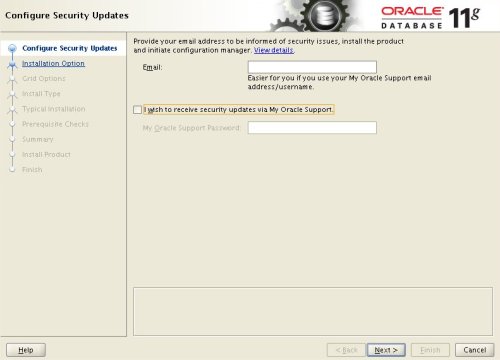
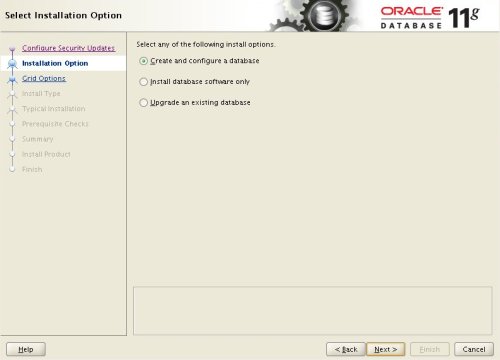
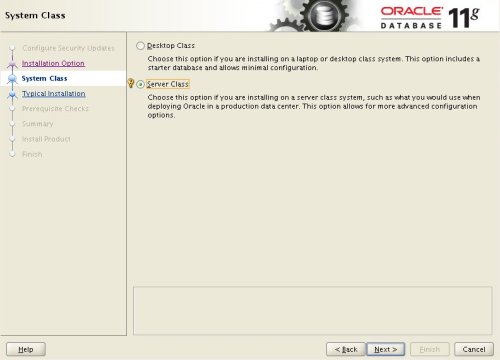
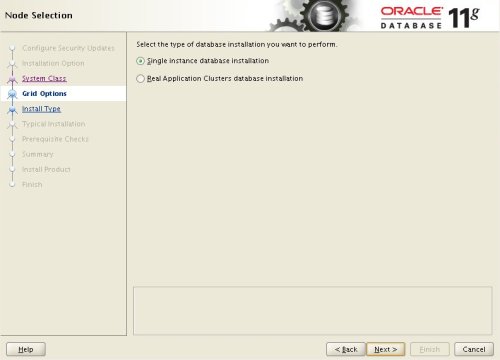
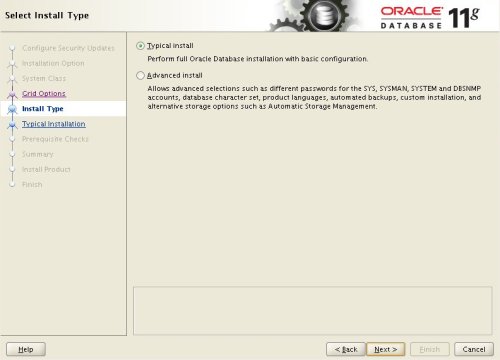
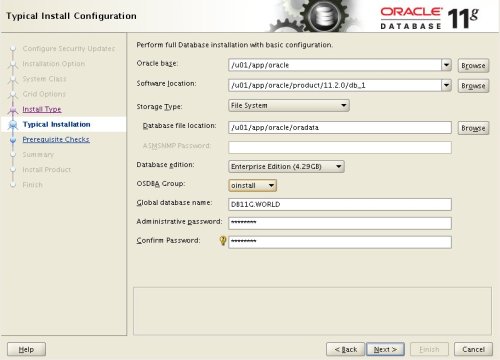
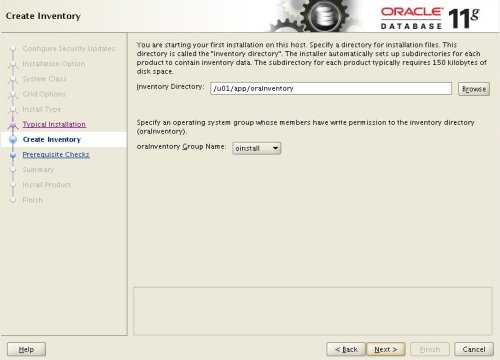
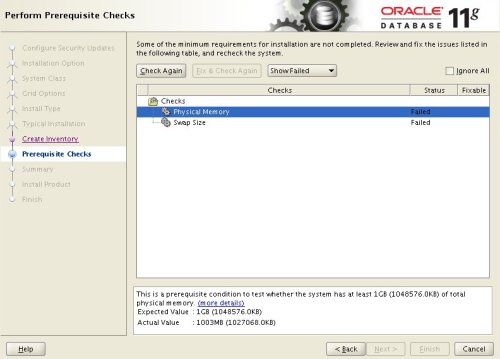
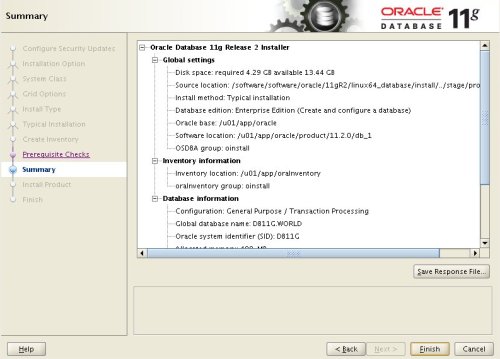
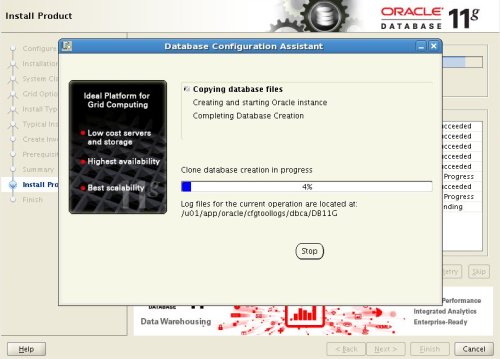
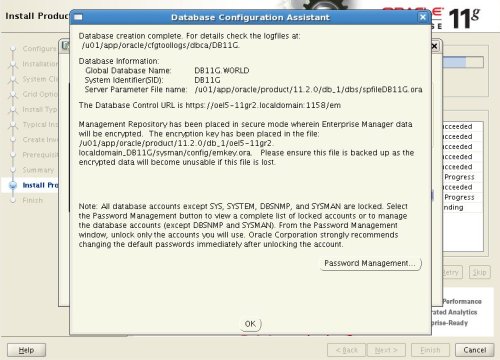
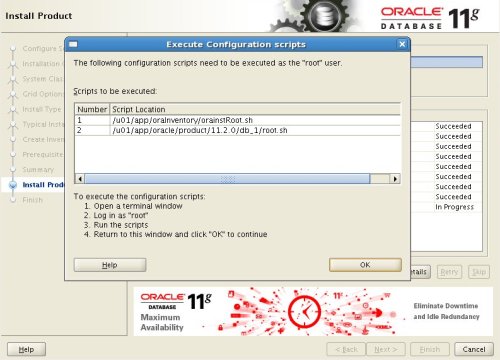
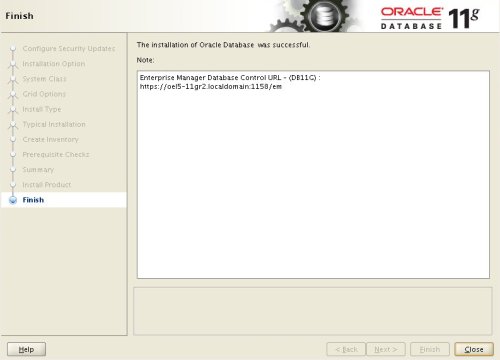
Proceed with the installation of your choice. You can see the type of installation I performed by clicking on the links below to see screen shots of each stage.
- Configure Security Updates
- Select Install Option
- System Class
- Node Selection
- Select Install Type
- Typical Install Configuration
- Create Inventory
- Perform Prerequisite Checks
- Summary
- Install Product
- Database Configuration Assistant
- Database Configuration Assistant 2
- Execute Configuration Scripts
- Finish
Post Installation
Edit the "/etc/oratab" file setting the restart flag for each instance to 'Y'.
DB11G:/u01/app/oracle/product/11.2.0/db_1:Y
Common Errors
"error code 35" : The machine name in the "/etc/hosts" file is not correct. It needs an entry for the loopback adapter (localhost) and the machine name. If you are using DNS for name resolution, you still need the loopback adapter reference in this file.
"error code 37" : The DNS not working properly. You may also get this error is the "/etc/hosts" file is not configured correctly.
"sqlplus: error while loading shared libraries: libclntsh.so.11.1" : The prerequisites have not been met. Work through them again. Specifically, make sure the "gcc" package has been installed.
Listener fails to start - Typically this is due to incorrect name resolution. Make sure the "/etc/hosts" and/or DNS is configured correctly.
Linking errors - Almost always due to missing prerequisites. Review the setup sections.
For more information see:
- Oracle Database Installation Guide 11g Release 2 (11.2) for Linux
- Automating Database Startup and Shutdown on Linux
- Oracle Universal Installer (OUI) Silent Installations
Hope this helps. Regards Tim...